
Geothermal Heating & Cooling Solutions in Des Moines and Ankeny
Geothermal systems represent the most energy-efficient, cost-effective, and environmentally friendly heating and cooling options available on the market today. By capturing free, renewable heat energy from the earth—which absorbs approximately 47% of the sun’s solar energy—a geothermal system provides high-performance air conditioning and heat in one integrated unit without relying on non-renewable resources.
This process works by efficiently transferring heat energy between the ground and your home or commercial building. As a leading HVAC provider in the region, Aspen Aire specializes in the professional installation and repair of geothermal heat pumps for residents in Ankeny, Des Moines, and throughout central Iowa, ensuring sustainable comfort for every season.

How Does a Geothermal Heat Pump Work?
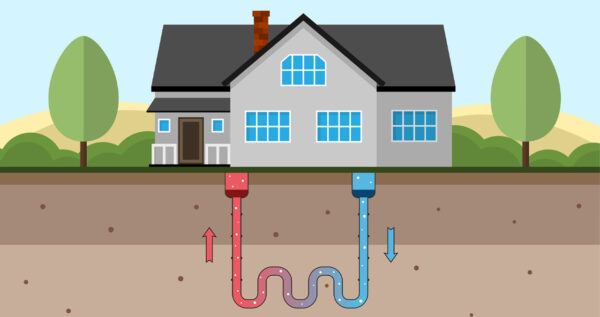
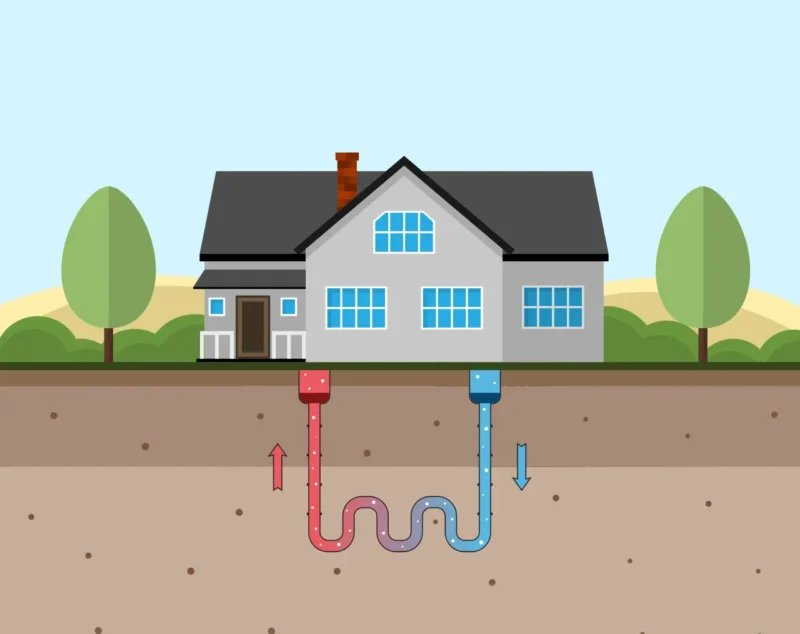
A geothermal system uses a heat pump to move heat from the home and into the cooler earth during the summer, and from the ground into the home during winter.
This transfer of heat energy is done through a series of pipes that are buried in the ground or sunk in a pond, or by using well water. Because a geothermal system moves heat instead of burning a fossil fuel to generate heat, it’s far more energy-efficient than a gas furnace.
The heat exchange pipes are buried in the ground below the frost line, usually about 6 to 10 feet deep. Refrigerant moves through these ground coils and deposits heat from inside the building when in cooling mode or absorbs heat from the ground when in heating mode.
Since the ground temperature stays relatively consistent at that depth, geothermal or ground source heat pumps operate more efficiently than standard air-source heat pumps, especially in winter.
Types of Geothermal Heat Pumps
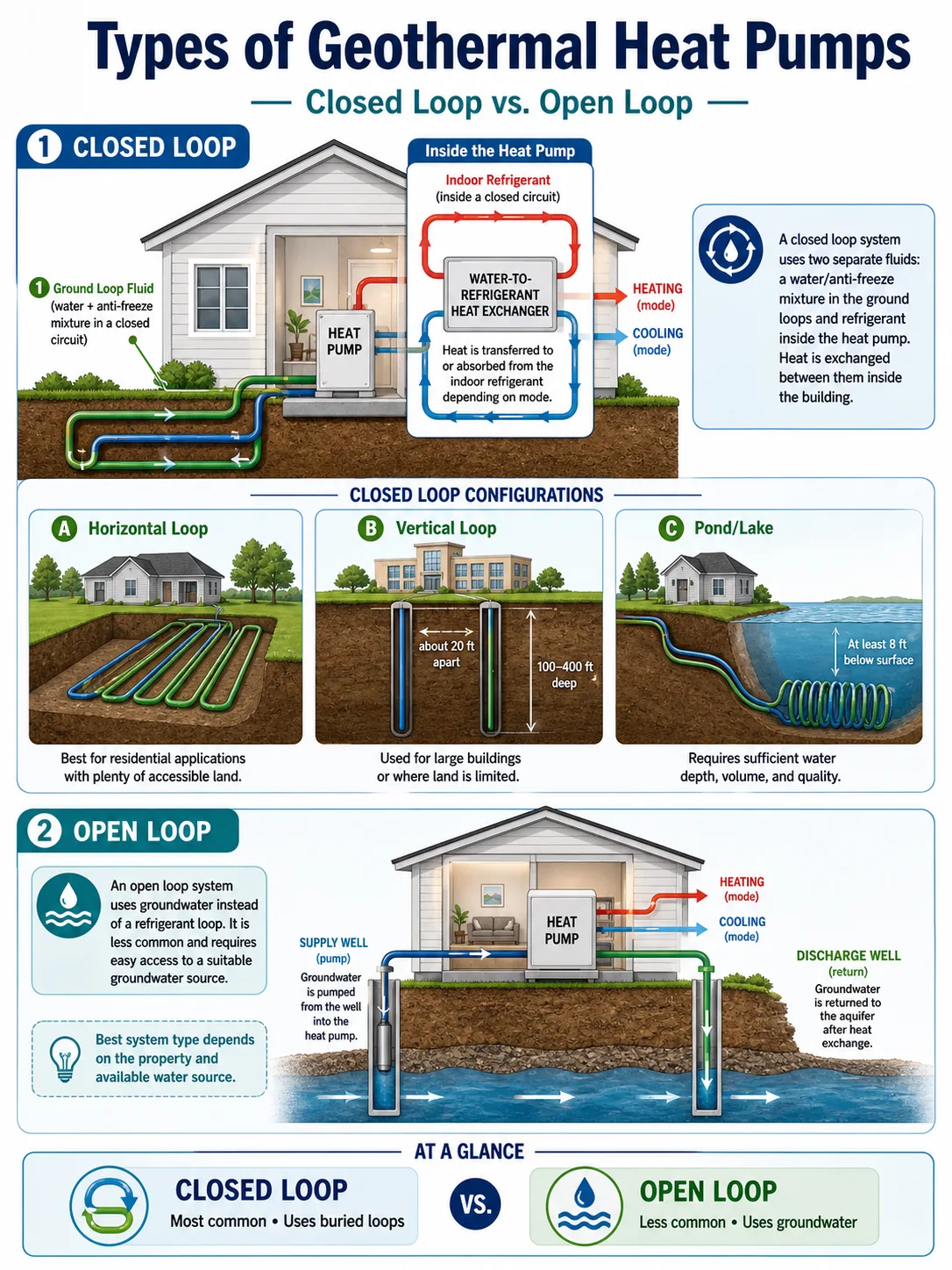
Closed Loop Systems: A closed loop geothermal system has 2 types of refrigerant: One that runs through ground loops and one that runs through the heat pump components inside the building. The refrigerant in the ground loops is a mix of water and anti-freeze that circulates in a closed cycle. The anti-freeze mixture passes through the ground loops and then enters a water-to-refrigerant heat exchanger inside the heat pump. There it either transfers heat to or absorbs heat from the indoor refrigerant, depending on whether it’s in heating or cooling mode. The indoor exchanger refrigerant is the same as that used in AC units.
The closed loop configuration can be horizontal, vertical or pond/lake:
- Horizontal Loop – Pipes are buried in deep trenches side-by-side and looped back and forth using either slinky or straight pipe loops. Horizontal loop is best suited for residential applications with plenty of accessible land.
- Vertical Loop – Two pipes are placed vertically into holes about 20 feet apart that go 100 to 400 feet deep. Vertical loop is typically used for large buildings and commercial facilities where there’s not enough land for a horizontal configuration.
- Pond/Lake – A supply pipe runs below ground from the building to the water. It’s then coiled circles at least eight feet below the water’s surface where it won’t freeze. The water has to have enough depth, volume and high enough quality.
Open Loop Systems: An open loop geothermal heat pump, or open loop system, uses ground water in place of refrigerant in the loops. This type of system is less common than closed loop systems because there has to be easy access to a source of ground water. Your Aspen Aire technician will be able to tell you whether an open loop system would work for your property or if a closed loop system would be best.

Benefits of Geothermal Heat Pumps
- Save 30-60% on heating costs compared to a typical gas furnace
- Save 20-50% on cooling costs compared to a typical air conditioner
- Highly efficient: Heat pumps move 3-5 units of heat for every unit of electricity it uses
- May be eligible for rebates or federal tax credits
- Uses renewable, clean energy by extracting heat from the earth
- With no combustion, there are no emissions
- One system can provide heat, cooling and even hot water
- Better suited for cold winters than standard heat pumps
- Install in new construction or retrofit a conventional HVAC setup
- Extremely quiet: There’s only an indoor unit and it’s about as loud as a refrigerator
- Minimal maintenance is needed
- Indoor components have a lifespan of about 25 years
- Ground loop components last 50 years or more
While a geothermal heat pump is a larger upfront investment than other HVAC systems, with tax rebates and energy savings the system can pay for itself in as little as 5 years.
Geothermal Heat Pumps We Carry
We carry a variety of geothermal heat pumps. In the Des Moines and Ankeny area, contact us today to discover your options and receive a free quote.
Frequently Asked Questions
What is a geothermal system?
A geothermal system captures free, renewable heat energy from the ground and uses it to heat and cool your home or business without burning fossil fuels.
How does a geothermal heat pump work?
It transfers heat from the earth into your home during winter and moves heat from your home back into the ground during summer using underground pipes filled with refrigerant or water.
What types of geothermal systems are available?
Closed-loop (horizontal, vertical or pond/lake) and open-loop systems are the most common. Your Aspen Aire technician can recommend the best option for your property.
What are the benefits of a geothermal system?
Benefits include lower energy bills, longer equipment life, quiet operation, no emissions, and eligibility for federal tax credits and rebates.
How long does it take to install a geothermal system?
Most installations are completed in a few days depending on loop system type and site conditions. Request a quote today.